Languages
Products


Info & new

Water softener: operation and maintenance
Water softener: how it works, regeneration, salt, resins and maintenance
A water softener is a system used to reduce water hardness, limit scale formation and protect systems, pipes, boilers, water heaters, appliances and professional equipment. Operation is normally based on ion-exchange resins and periodic regeneration with brine.
Related topics
How a water softener works
Ion-exchange resins
Water passes through a resin bed that retains calcium and magnesium, the main minerals responsible for hardness. This reduces scale formation in systems and connected equipment.
Water passes through a resin bed that retains calcium and magnesium, the main minerals responsible for hardness. This reduces scale formation in systems and connected equipment.
Resin regeneration
After treating a certain volume of water, the resins must be regenerated with a water and salt solution. Regeneration restores the exchange capacity of the resins.
After treating a certain volume of water, the resins must be regenerated with a water and salt solution. Regeneration restores the exchange capacity of the resins.
Control valve
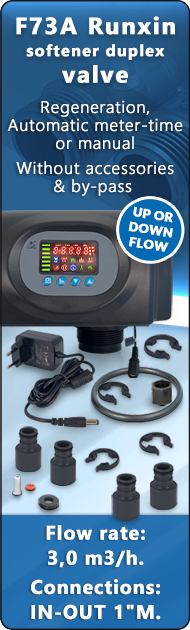
The valve manages service, backwash, brine draw, rinse and brine tank refill phases, depending on the type of softener and the programmed settings.
The valve manages service, backwash, brine draw, rinse and brine tank refill phases, depending on the type of softener and the programmed settings.
Types of water softeners
Cabinet water softeners
Cabinet softeners integrate the resin tank and brine tank into a single compact cabinet. They are suitable when a neat, space-saving and simple installation is required.
Cabinet softeners integrate the resin tank and brine tank into a single compact cabinet. They are suitable when a neat, space-saving and simple installation is required.
Two-body water softeners
In two-body softeners, the resin tank and brine tank are separate. This configuration is useful when higher capacity, more installation flexibility or larger volumes are required.
In two-body softeners, the resin tank and brine tank are separate. This configuration is useful when higher capacity, more installation flexibility or larger volumes are required.
Duplex water softeners
Duplex systems use two columns to provide greater service continuity. They are suitable for professional applications or situations where softened water must be continuously available.
Duplex systems use two columns to provide greater service continuity. They are suitable for professional applications or situations where softened water must be continuously available.
What to check before choosing
Water hardness
Before choosing a softener, it is important to know the hardness of incoming water. Sizing depends on hardness value and expected daily water consumption.
Before choosing a softener, it is important to know the hardness of incoming water. Sizing depends on hardness value and expected daily water consumption.
Water consumption
The number of users, type of installation and water demand determine the required softener capacity and regeneration frequency.
The number of users, type of installation and water demand determine the required softener capacity and regeneration frequency.
Space and drain connection
Installing a softener requires available space, hydraulic connection, drain for regeneration, electrical outlet and easy access for salt loading.
Installing a softener requires available space, hydraulic connection, drain for regeneration, electrical outlet and easy access for salt loading.
Water softener maintenance
Salt level check
The brine tank must contain an adequate amount of salt to allow regeneration. Insufficient salt level can compromise softener operation.
The brine tank must contain an adequate amount of salt to allow regeneration. Insufficient salt level can compromise softener operation.
Cleaning and sanitizing
Periodic checks, brine tank cleaning, valve inspection and system sanitizing should be scheduled according to use and water conditions.
Periodic checks, brine tank cleaning, valve inspection and system sanitizing should be scheduled according to use and water conditions.
Residual hardness check
Periodically checking outlet water hardness helps determine whether the softener is working correctly or whether settings and maintenance are required.
Periodically checking outlet water hardness helps determine whether the softener is working correctly or whether settings and maintenance are required.
Helpful tip:
A water softener must be sized according to water hardness and real consumption. A system that is too small regenerates frequently and works poorly, while an oversized system may be less efficient if not correctly programmed.
A water softener must be sized according to water hardness and real consumption. A system that is too small regenerates frequently and works poorly, while an oversized system may be less efficient if not correctly programmed.